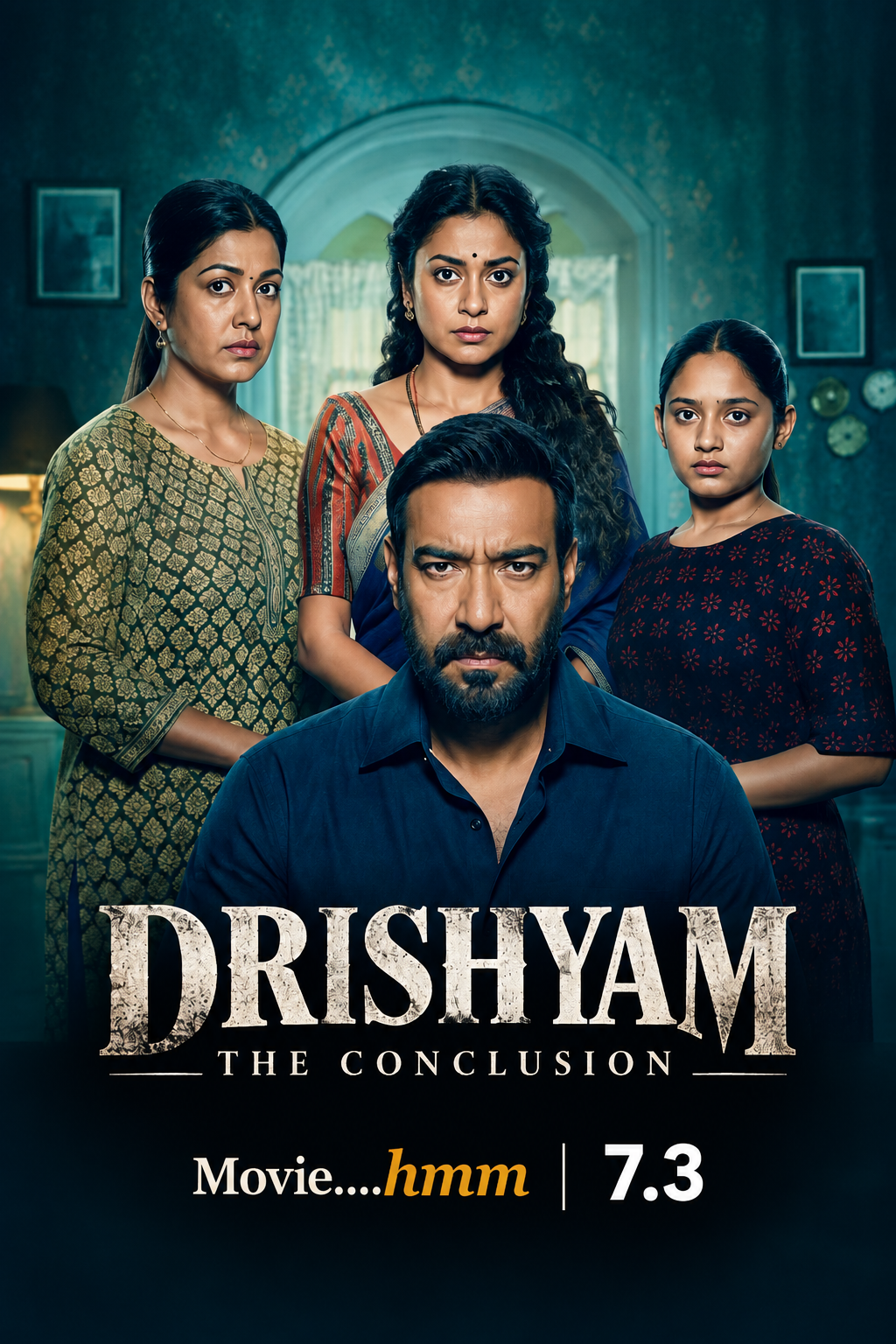
Drishyam: The Conclusion
It takes too long to show its hand, but when Drishyam finally plays its last card, the climax gives the film the relief it desperately needed.
Drishyam: The Conclusion has an unusual problem: the audience already knows Vijay Salgaonkar too well. We know he is thinking ahead. We know the police are probably looking in the wrong direction. And every time the film tells us Vijay is trapped, part of us is already waiting to discover what he has secretly arranged. That familiarity makes this third film harder to pull off than the first two.
For a long stretch, you can feel that struggle. The film is heavily dialogue-driven. People sit, stand, walk, smoke, explain, threaten and discuss. The investigation sometimes feels less like detectives discovering something and more like characters talking us toward the next development.
The new Crime Branch officer has tremendous screen presence, but the writing does not always justify the reputation built around him. He talks with authority, delivers philosophical lines and carries himself like the man who will finally crack Vijay. I kept waiting for more actual investigation from him. At times he feels more like an SP tag and a source of speeches than a truly dangerous investigator.
There is also a lot of smoking. At some point it starts feeling less like character behaviour and more like a visual habit of the film.
Ajay Devgn remains the reason the Hindi Vijay Salgaonkar works. There is no physical pressure in his performance, no unnecessary heroism and no need to convince us through shouting. He walks, watches and talks when necessary, and you keep wondering what is happening behind that expression. That settled quality is exactly right for Vijay.
Jaideep Ahlawat provides the opposite energy. His swagger, dialogue delivery and presence give the investigation some life even when I wished his character actually did more. Prakash Raj is dependable and adds weight whenever the film needs authority.
Shriya Saran is where I felt a disconnect. Nandini is supposed to belong to an ordinary family that has been carrying extraordinary fear for years, but some of the styling, expressions and presentation feel too polished and modern for the emotional texture I associate with this family. More importantly, the screenplay does not give the family enough emotional space.
The first half drags more than it should. The film keeps talking around the investigation without giving enough fresh movement. But the second half is where the point of the movie finally becomes clear. The pieces begin moving, the conversations start producing consequences, and you begin watching Vijay rather than merely listening to people talk about him.
The final stretch is easily the film's strongest portion. The climax is clever enough to send you out of the theatre thinking about how everything was arranged. I liked the climax, but I would not call it flawless. There is a difference between surprising the audience and making the audience believe, after the surprise, that everything could really have happened that way.
The original Drishyam was exceptional because Vijay's impossible plan gradually became believable. Here, a few developments feel convenient. Still, the climax works where it matters most: it gives you that Drishyam feeling again. After a film that sometimes feels unnecessarily stretched, that is a considerable relief.
For anyone who has followed the Malayalam Drishyam films, the comparison is unavoidable. Something is still missing here compared with the Malayalam experience. It is not simply Mohanlal versus Ajay Devgn; Ajay is very good. The difference is the feeling of reality. The best Drishyam works because an ordinary family gets pushed into an extraordinary situation and you almost forget you are watching a constructed thriller.
The Hindi conclusion is more visibly a thriller. It has stars entering scenes like stars, punch lines, attitude, stylish police officers and courtroom confrontation. It knows the audience is waiting for Vijay's next trick. That makes it entertaining, but slightly less organic.
One thing works strongly in the film's favour: it does not need conventional songs or romantic diversions. The movie is largely interiors, conversations, investigation and confrontation. Despite the dragging portions, one question keeps carrying it forward: what has Vijay already done that we do not know about?
Overall, Drishyam: The Conclusion is not a casual time-pass movie. It asks you to listen, remember and wait, and sometimes it makes you wait too long. The investigation could have been sharper, the first half could have lost some dialogue, the SP needed more detecting and fewer declarations, and the family needed more emotional presence.
But Ajay Devgn remains completely at home as Vijay Salgaonkar. Jaideep Ahlawat gives the film a strong adversarial presence. Prakash Raj adds weight. And when the movie finally reaches its last move, the climax earns the audience's attention. Viewers who closely follow the Malayalam films may find this more commercial and less natural, but the Hindi franchise audience is likely to respond strongly.
You may question the journey. You may even see some of the tricks coming. But you are likely to walk out discussing the climax. And for Drishyam, that is probably the point.
Ajay Devgn's restrained performance, Jaideep Ahlawat's presence, the dialogue-driven tension, a strong second half and a climax that gives the film its Drishyam payoff.
An unnecessarily stretched first half, too much talking instead of investigation, reduced family emotion, some convenient plotting and less natural texture than the Malayalam Drishyam experience.