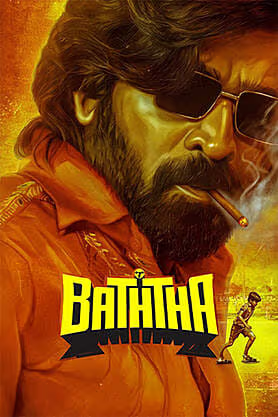
Baththa
A man who made himself big through fear is made helpless by a child — and eight days behind one locked door quietly change what freedom, family and an unfinished childhood dream mean to him.
Baththa has a gangster, a child, a locked washroom and a mystery. But strangely, none of those is what stayed with me most. What stayed with me was childhood.
I have always believed childhood is not merely the first chapter of somebody's life. Sometimes it quietly writes the chapters that follow. An insult, humiliation or fear that adults dismiss in seconds can remain inside a child for years. The adult we eventually meet may still be reacting to something that happened to that child long ago.
Baththa has spent years becoming a man people fear. His reputation makes him look big. The film then finds a beautifully ironic way of making him small again: it locks him inside a washroom. Suddenly his name, power and intimidation are useless. He cannot threaten his way into fresh air. He cannot intimidate hunger. His reputation cannot open a locked door.
That is where the child becomes important. The child artist is not decoration or simply a source of cuteness. A child's imagination can move in directions adults no longer understand. Something insignificant to a grown-up can become enormous inside a small mind. There is an interesting reversal here: Baththa has spent his adult life frightening others, but it takes the fear and innocence of a child to confront him in a way another rowdy probably never could.
The eight days inside that room are the film's most useful idea. Take ordinary things away from somebody long enough and they stop being ordinary. Food changes when you have been hungry. Fresh air changes when you have been trapped. Family changes when you cannot reach them. Freedom changes when somebody else controls the door. When Baththa returns to these things, he is not returning to the same life because he is no longer experiencing it in the same way.
But the washroom is not necessarily Baththa's first prison. His childhood humiliation around singing and the dream that never completely disappeared interested me even more. A person can become feared, powerful and completely different on the outside while an unfinished childhood dream remains somewhere underneath. He still carries that desire to sing, practices around the school and has the possibility of singing at his daughter's function. Then life locks him away again.
So I saw two prisons in Baththa. One keeps him inside a washroom for eight days. The other has kept a part of him locked away for years. One door needs somebody outside to open it. The other needs Baththa himself.
There is almost a spiritual simplicity to the transformation. Sometimes change does not arrive through another powerful man. It arrives through innocence. Call it God, childhood or simply life's strange sense of humour — the feared adult is made vulnerable through a kid.
I also liked the nostalgic texture of the film. The costumes and period atmosphere give it warmth instead of feeling like decoration. The child's performance is particularly important, and Vijay carries the personality of Baththa well. I did feel Vijay could concentrate more on his physical fitness for the gangster side of the character, but the performance becomes more interesting when the film strips away that gangster image and allows vulnerability to enter.
The second half also carries a simple suspense effectively: who actually locked the door? The film holds that question long enough to keep us engaged, and the eventual reveal and ending work because the mystery is connected to the emotional journey rather than existing only for a twist.
Baththa is not a flawless film, and some portions could have been tighter. But it is a decent film with a thought that stayed with me. We spend years trying to become bigger, and sometimes life has to make us small again before we notice what was already around us.
Food tastes different after hunger. Air feels different after confinement. Family feels different after separation. And an old dream feels different when life unexpectedly gives it another chance.
For me, Baththa works best when it stops being a rowdy film and becomes a film about the frightened child still living somewhere inside an adult.
The child artist, Vijay's vulnerable side, the eight-day confinement idea, childhood humiliation and the unfinished singing dream, nostalgic costumes and atmosphere, and the second-half mystery.
Some portions could be tighter, the tonal movement is not always equally smooth, and Vijay's physical sharpness could better support the gangster side of the character.
AI-generated review? Nope. I watch. I think. I judge. I rate. Technology just makes sure my English survives the journey from my head to your screen. The “hmm” is completely mine. 🤔
What did you think?
Your movie. Your reaction.