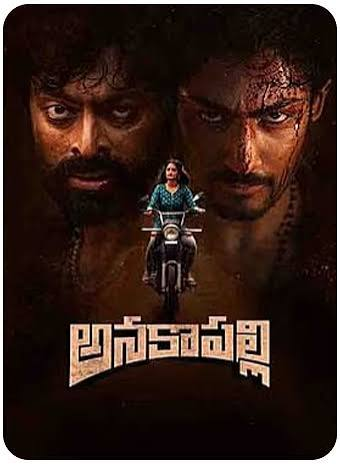
Anakapalli
Anakapalli doesn't discover a new road for the rural revenge drama. What saves it is that some of the people travelling that old road feel real.
There is something almost dangerous about making this kind of Telugu film now. Village. Carefree youngster. Love. Local gangster. Loyalty. Betrayal. Revenge. We have travelled this road many times. So Anakapalli has a problem even before its first fight begins: familiarity.
The film does not completely solve that problem. But occasionally it reminds us that a familiar story can still work when the people inside it have enough blood running through them.
The first thing I liked is the soil. Anakapalli itself feels important. If you are going to tell an old-fashioned rural action story, the place cannot merely exist behind the actors. The local flavour, people, attitudes and roughness give the movie an identity that the underlying story does not always have.
Without that texture, this could have happened in almost any commercial Telugu movie village. With it, the film at least has a smell, temperature and personality of its own.
Vikram Sahidev does not enter the film with the comfort of an established star, and that actually helps. There is some rawness, but he does not look frightened by the camera or by the commercial demands of the role.
What I want from him going forward is not simply more mass. It is more interiority. A hero raising his voice is easy. A hero making us understand what is happening inside him before he raises his voice is much harder. Anakapalli gives us glimpses of that actor.
Tarak Ponnappa as Bullet is one of the film's stronger assets. A villain does not become dangerous because the background score tells us he is dangerous. Presence matters. Stillness matters. The possibility that he might do something can sometimes be more effective than watching him do something every five minutes.
That weight makes the hero-villain equation more interesting than the screenplay itself sometimes manages to be.
Then comes the interval. This is where Anakapalli finally changes temperature. Until then, the movie spends considerable time assembling its world, romance and relationships. The interval gives the story urgency and for a while the movie we were waiting for arrives.
But a strong interval cannot retroactively make a slow setup sharp. A powerful background score cannot make a predictable scene unpredictable. Emotional intention also does not automatically create emotional impact.
At around two hours and thirty-four minutes, Anakapalli asks for a considerable amount of our time. For that investment, I wanted more surprise from the screenplay.
The movie knows the checkpoints of this genre extremely well. Sometimes too well. Love, conflict, gangster influence, family emotion, betrayal and revenge arrive with a familiarity that allows us to see portions of the road before the characters reach them.
The problem is not that we have seen these things before. We watch familiar love stories, police films and revenge dramas every year. The problem comes when a movie does not give us a new reason to see those things again.
Davzand's music and background score give the old engine additional horsepower. When the screenplay travels familiar territory, sound can change the emotional temperature of a scene. Several commercial moments gain force because of the score.
But music should amplify emotion. It should not have to manufacture it. There are places where Anakapalli comes close to asking the background score to perform emotional work that stronger writing should have completed first.
The interesting thing about Anakapalli is that audience enthusiasm appears stronger than much of the critical response. I do not think that necessarily means audiences believe they have discovered a revolutionary screenplay.
It may simply mean the film gives a section of the audience something they still enjoy: a rooted commercial drama that is not embarrassed about being one. That deserves acknowledgement.
There are two ways to make an old story work. Tell it in a completely new way, or tell it with enough conviction that we temporarily stop caring that it is old.
Anakapalli does not consistently achieve the first. At its better moments, it gets surprisingly close to the second.
That is why I would not dismiss it as routine and walk away. There is a decent commercial film here. There is a promising lead actor here. There is an effective antagonist here. There is local flavour and audience connection here.
But there is also a screenplay that needed to ask itself one more difficult question: We have seen this before. What are we giving the audience this time that they have not?
Vikram Sahidev, Tarak Ponnappa, the rooted Anakapalli atmosphere, interval block, background score and the film's commitment to being a local commercial drama.
Familiar revenge writing, predictable progression, slow stretches and a 154-minute runtime that needed tighter screenplay and editing control.
AI-generated review? Nope. I watch. I think. I judge. I rate. Technology just makes sure my English survives the journey from my head to your screen. The “hmm” is completely mine. 🤔
What did you think?
Your movie. Your reaction.